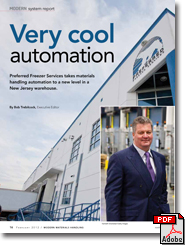
Preferred Freezer Services system walk-through
Preferred Freezer Services’s new facility maximizes throughput while minimizing labor and energy consumption.
Latest Logistics News
Under-21 driver pilot program a bust with fleets as FMCSA seeks changes Diesel back over $4 a gallon; Mideast tensions, other worries cited Four U.S. railroads file challenges against FRA’s two-person crew mandate, says report XPO opens up three new services acquired through auction of Yellow’s properties and assets FTR’s Trucking Conditions Index weakens, due to fuel price gains More NewsPreferred Freezer Services; Elizabeth, N.J.
Size: 170,000 square feet, including 140,000 square feet of AS/RS
Products handled: frozen food products
Stock keeping units: 2,000 across multiple clients
Throughput: 1,020 pallets per day in and out of the facility
Employees: 30
Shifts/Days: 3 shifts/5.5 days
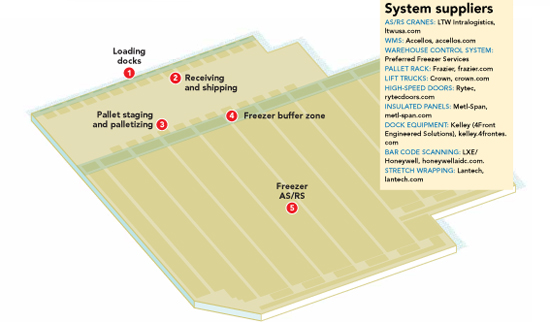
Receiving: When trailers are backed into a loading dock (1), the back portion of the trailer extends into the facility. This allows PFS to open the trailer doors inside the warehouse, minimizing the exchange of air with the outside. Trailers are unloaded by lift trucks or pallet jacks and staged in the receiving and shipping area (2). Pallets receive a license plate bar code that identifies the product and the customer. The bar code is then wirelessly scanned and the pallet is staged for induction into the automated storage and retrieval system (AS/RS).
Putaway: The automated system operates without conveyor. Instead, cranes can reach pick up and drop off staging and palletizing locations (3) near the freezer entrance. The system is a dual-cycle system. That means that the crane retrieves a pallet for picking each time it exits the freezer to pick up a pallet for storage. When pallets are ready for putaway, the warehouse control system sends a signal that opens a high-speed door and directs a crane to a pick up location. The crane drops off pallets (3) retrieved from storage, and picks up two pallets for putaway. The pallets are dropped off at one of several hundred freezer buffer locations (4) inside the 140,000-square-foot freezer AS/RS (5). Later, the crane will pick up a pallet from a buffer location and deliver it to a storage location inside the freezer AS/RS (5) based on throughput metrics for that stock keeping unit (SKU) and the customer. Pallets are now available for orders.
Picking and shipping: Order fulfillment takes place in the receiving and shipping area (2) on the dock. Full pallets are delivered from the drop off location directly to a trailer (1) for delivery. Mixed pallets are manually palletized in the receiving and shipping area (2). When the picks from a pallet are completed, the crane will remove the partial pallet and return it to the freezer buffer area (4) for putaway (5) later. The completed pallet is stretch-wrapped and loaded into a trailer (1) for delivery.
System suppliers
AS/RS cranes: LTW Intralogistics
WMS: Accellos
Warehouse control system: Preferred Freezer Services
Pallet rack: Frazier
Lift trucks: Crown
High-speed doors: Rytec
Insulated panels: Metl-Span
Dock equipment: Kelley (4Front Engineered Solutions)
Bar code scanning: LXE/Honeywell
Stretch wrapping: Lantech

Article Topics
Latest in Logistics
Under-21 driver pilot program a bust with fleets as FMCSA seeks changes Diesel back over $4 a gallon; Mideast tensions, other worries cited Four U.S. railroads file challenges against FRA’s two-person crew mandate, says report XPO opens up three new services acquired through auction of Yellow’s properties and assets FTR’s Trucking Conditions Index weakens, due to fuel price gains U.S. rail carload and intermodal volumes are mixed, for week ending April 6, reports AAR LM Podcast Series: Examining the freight railroad and intermodal markets with Tony Hatch More LogisticsAbout the Author

Subscribe to Logistics Management Magazine

Find out what the world's most innovative companies are doing to improve productivity in their plants and distribution centers.
Start your FREE subscription today.
April 2023 Logistics Management

Latest Resources