Realizing Global Trade Management Potential
As the global trade engine kicks back into gear, new demands for electronic notifications and the need for better, more efficient trade compliance are buoying the global trade management market. Are you prepared to harness your organization’s global opportunities?
Let’s cut to the chase: Global Trade is on a tear.
According to the World Trade Organization’s (WTO) latest numbers, global trade grew by 13.5 percent in 2010 after falling 12.2 percent in 2009. It was the fastest-ever annual expansion in global commerce, reports the WTO—which originally forecasted a 10 percent increase—and an unexpected jump that comes on the heels of a long-awaited economic recovery.
Last year’s global trade expansion also marked the fastest year-over-year growth ever recorded in a data series that dates back to 1950, according to the WTO, and is sure to bring even more shippers into the international market in 2011. Which begs the question: Will those companies be ready to handle the rigors and challenges of doing business overseas?
The quick answer is “no,” particularly in regards to the IT necessary to navigate the increasingly complex maze of global trade. According to ARC Advisory Group’s latest Global Trade Management (GTM) Worldwide Outlook Study, most small and midsize companies still rely on manual processes to manage their global trade operations, particularly their exports. Not only is this approach costly and inefficient, ARC reports, but it also makes it difficult or impossible for companies to remain in compliance with Customs regulations.
“The fact that companies need to stay on top of trade content, which is changing all the time, is a key driver of GTM sales,” says Steve Banker, director of supply chain solutions at ARC Advisory Group.
The need for better, more efficient trade compliance and new demands for electronic notifications (which must now be filed before goods are shipped to certain countries) are buoying the GTM market, which, like many other supply chain software sectors, saw sales flatten when the nation was in the throes of recession.
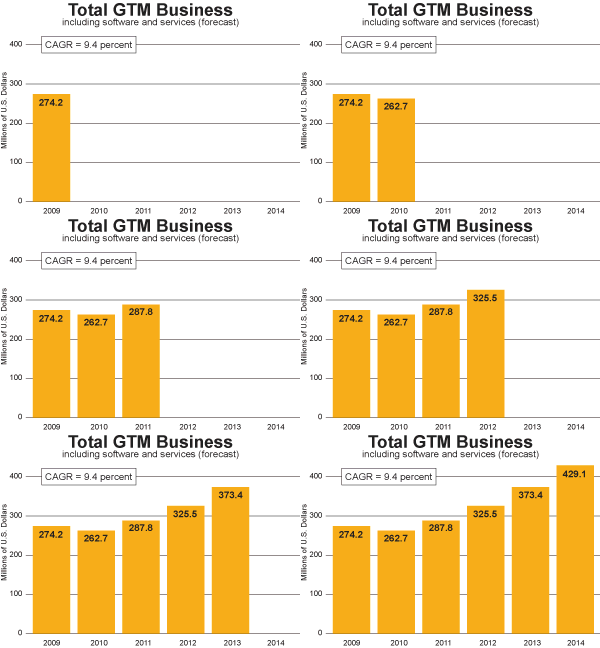
Expect that situation to turnaround in 2011, says Banker, who predicts an average growth rate of 9.4 percent annually for GTM software through 2014. “That’s fairly strong growth in one of the fastest-growing segments of the software industry,” says Banker.
Over the next few pages, we’ll delve deeper into the GTM space to find out who’s using the software, how it’s being used, and what new developments will come to market this year. Then, we’ll show you how one shipper is using GTM to work smarter, better, and faster in the global economy.

Gaining momentum
As the global economy emerges from recession and more companies do business with overseas partners and customers, the adoption rates for GTM are sure to rise. To manage, companies are using software programs that can juggle the stringent requirements and regulatory issues associated with international trade.
CEOs are now waking up to that fact, says Belinda Griffin-Cryan, global supply chain executive program manager at Capgemini Consulting in Boston, and are integrating GTM into their overall operational strategies.
“It’s now become a strategic, C-level executive topic, with everyone trying to figure out global trade management’s place in the overall organization.”
Credit political moves like the new free trade agreements—including the one that the U.S. recently signed with South Korea—with elevating GTM’s profile, says Griffin-Cryan. “Shippers are realizing the potential for large shifts in global trade flows,” she adds, “and the need to better manage that aspect of their operations.”
Disruptive events like the eruption of the Icelandic volcano in 2010, increased security concerns, and industrial actions taking place in Europe have also pushed more companies to turn to IT to handle their global operations, says Griffin-Cryan. “Shippers realize that we’re in a dynamic period in global trade right now,” she explains, “and see GTM as a way to capitalize on those opportunities while staying compliant, and on the right side of the regulatory requirements, without too much effort.”
Expect that push to continue well into 2011, says William McNeill, senior research analyst for global trade management at Gartner, which estimated that 53 percent of shippers increased spending on GTM applications in 2010, with another 25 percent “holding spending levels steady” for the software.
“Only a small percentage said that they were going to decrease spending on GTM,” says McNeill, who at press time was working on the 2011 study. “It’s been consistent every year that we run this particular study with a group of 150 respondents who are pretty enthusiastic about GTM applications.”
Applications run the gamut
Today’s GTM applications offer a range of functionalities that are anything but stagnant. In fact, this supply chain software sector is constantly morphing to meet the needs of the global trade environment, which is both unpredictable and dynamic.
At a high level, ARC’s Banker says GTM solutions automate a variety of trade activities that include performing restricted party screenings and embargo checks; assigning export and import licenses; creating and filing trade documents; and communicating electronically with Customs authorities.
GTM software can also facilitate product classification; manage Customs processes and transit procedures; facilitate restitution handling; and determine preferential trade eligibility. Such systems are offered up in both purchase-and-install and software-as-a-service (SaaS) or “cloud” formats, the latter of which is gaining traction among those shippers who want to get their GTMs up and running quickly, and with lower upfront investments and less stress on their internal IT teams.
Additionally, he says because global partners are accustomed to sharing trade information through electronic means like EDI, the move to an SaaS-based GTM is a natural transition for them.
“The cloud-based GTM is the final evolution,” says McNeill. “In fact, the trend is so strong that we expect GTM to drive a 25 percent increase in SaaS supply chain management applications by 2013.” In terms of functionality, McNeill expects most applications to continue focusing on logistics, compliance, and finance—the latter of which is an area that’s ripe for improvement.
“Finance is the untapped area of GTM right now, with more functionality being developed around the support of financial processes and how to link that directly to the supply chain,” says McNeill. A company that wants to extend credit to an overseas customer, for example, would benefit from a GTM that allows for the examination of purchase orders and commercial invoices before such decisions are made. “With SaaS growing, those functions could become even easier for shippers to handle with their GTMs in the near future.”
The popularity of cloud-based GTMs is also pushing more vendors into the space, says McNeill, who expects that trend to continue well into 2011. The business-to-business vendors that were already transmitting trade and Customs information to and from business partners, for example, are jumping into the fray thanks to SaaS’ lower barriers to entry. “We’ve talked to about 12 different vendors who have told us that they’re getting into the cloud-based supply chain management arena, which includes GTM,” says McNeill. “I really think we’re going to see that explode this year.”
GTM in action
With GTM gaining traction and the global economy in growth mode, companies like Cadence Design Systems of San Jose, Calif., picked up on the need for a GTM early and for the last 10 years has relied on the system to ensure compliance and create a streamlined, global supply chain.
Specializing in Electronic Design Automation (EDA), or software tools that engineers use to design electronic systems such as printed circuit boards and integrated circuits, Cadence installed its Kewill Export Compliance System (ECS) and Reverse Denied Party Screening (RDPS) products.
Larry Disenhof, group director of export compliance and government relations for Cadence, says most of the firm’s sales and software transfers are handled electronically through sales, research, and development offices in India, China, Japan, Europe and Israel. Disenhof says that the firm’s GTM fulfills several functions, the most important of which is ensuring that no products are shipped to terrorist countries, or to companies or individuals that are listed as denied parties.
Using the RDPS, for example, Disenhof stays on top of both new and existing customers that must be checked against a list of about 28,000 denied parties. The system syncs weekly with that government list, and notifies Disenhof of any possible conflicts.
On several occasions, for example, the RDPS has identified denied parties, thus allowing Disenhof to work with Cadence’s order administrators to “shut them off, and warn the rest of the company that we can’t do business with these customers.”
Other times, the system alerts Disenhof to the need for a special export license, based on the customer’s location. And once in a while, the GTM solution gets overzealous and generates false positives that need further investigation before any orders are canceled. “There’s a company on the denied party list called Technology Options India Private Ltd.,” Disenhof explains, “so we get false positives whenever the system checks against commercial enterprises in India.”
Disenhof, who remembers a time when such compliance was handled manually, says Cadence’s GTM system adds a layer of protection that would be impossible to achieve without technology. “Export compliance is way too much of a burden to handle manually,” says Disenhof. “Using a GTM makes the process quick, and requires just a simple entering of a customer name and destination to get an immediate response. We can then clear the ‘no’ response by getting more information about the customer, or by stopping the order and moving onto the next task. It’s as easy as that.”
For more information on the latest news and insight revolving around global trade visit our Critical Topics Global Trade Section.

Article Topics
Global Trade News & Resources
Maryland DOT: $1.9 billion and up to four years to rebuild bridge sunk near Baltimore port Baltimore suing ship that crashed into bridge, closing port, costing jobs UPS reports first quarter earnings decline Supply Chain Stability Index sees ‘Tremendous Improvement’ in 2023 Descartes March Global Shipping Report highlights ongoing steady volume momentum U.S.-bound import growth track remains promising, notes Port Tracker report EU Update 2024: Crises lead to growth More Global TradeLatest in Logistics
UPS announces CFO Newman to leave company, effective June 1 Preliminary April North American Class 8 net orders are mixed Senators take a close look at Amazon with Warehouse Worker Protection Act Despite American political environment, global geopolitical risks could be easing Maryland DOT: $1.9 billion and up to four years to rebuild bridge sunk near Baltimore port April Services PMI contracts after 15 months of growth, reports ISM 2023 industrial big-box leasing activity heads down but remains on a steady path, notes CBRE report More LogisticsAbout the Author

Subscribe to Logistics Management Magazine

Find out what the world's most innovative companies are doing to improve productivity in their plants and distribution centers.
Start your FREE subscription today.
May 2024 Logistics Management

Latest Resources